
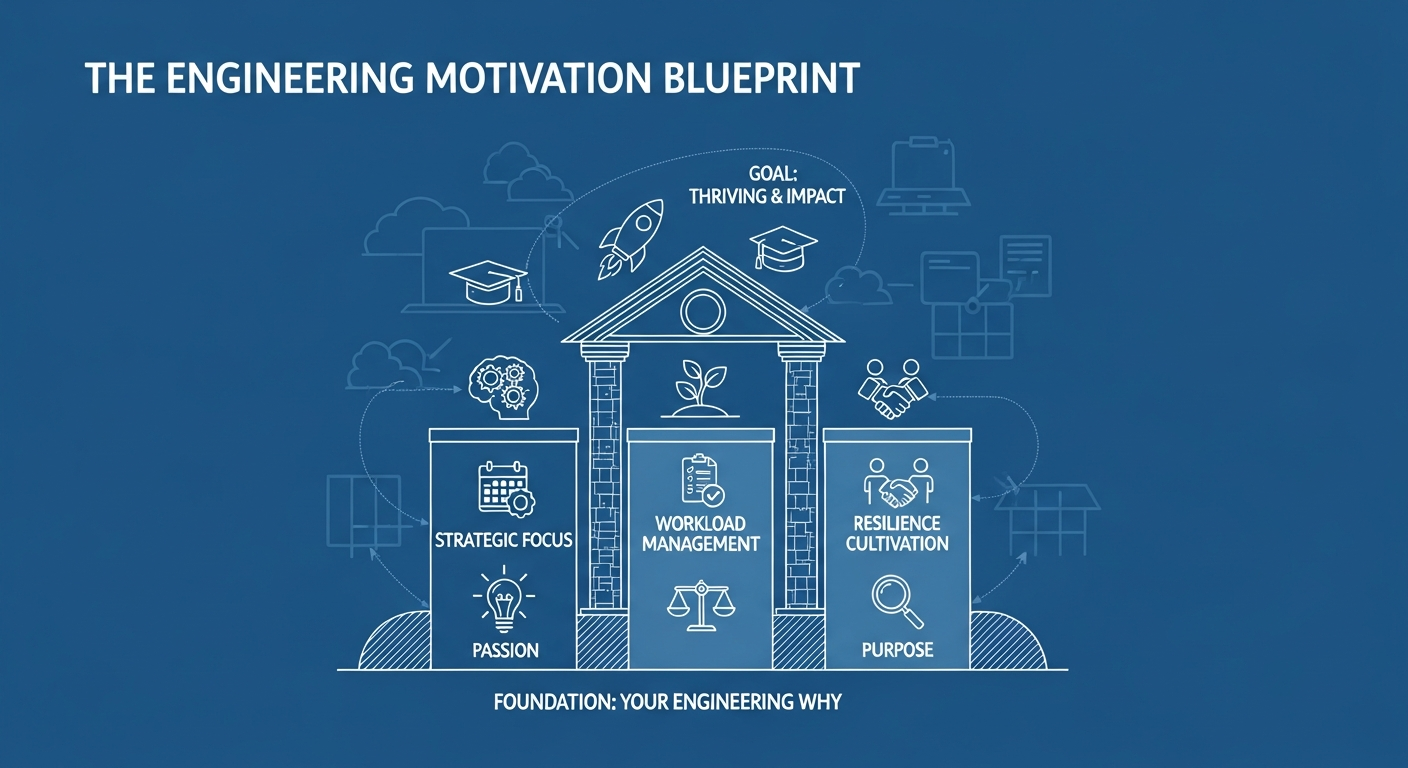
The Engineering Motivation Blueprint: How to Thrive Through Tough Semesters
Navigating the Peaks and Valleys of an Engineering Degree
It’s 2 am, and the only things keeping me company are a half-empty Coke can and a thermodynamics problem that seems to defy the laws of physics I’m supposed to be mastering. Every engineering student knows this moment: the point in a tough semester where passion feels distant and perseverance (and a little bit of spite) is the only fuel left. Maintaining engineering student motivation can be challenging, especially when the allure of a rewarding career feels worlds away, buried under assignments, looming exams, and complex theories. The struggle is REAL. In fact, research shows that a significant portion of engineering student attrition happens during the first year, highlighting the immense pressure from the start.
The Reality of Engineering: Beyond Passion to Perseverance
An engineering degree is a marathon, not a sprint. It’s a rigorous journey that tests not just your intellectual capacity, but your mental fortitude. The initial passion that drew you to engineering, the desire to build, innovate, and solve problems, is the spark. But passion alone won’t get you through a brutal class schedule or a failed midterm. True success in college requires discipline and a strategic approach to motivation. It’s about building a system that carries you through the inevitable valleys so you can appreciate the peaks.
What This Blueprint Offers: A Strategic Guide to Sustained Motivation

During my four years as an undergraduate engineering student, I’ve developed a personal system that helps me navigate these challenges. It’s not about finding a magic bullet for motivation; it’s about constructing a reliable framework to sustain focus, manage workload, and cultivate resilience. This blueprint is my strategic guide to not just surviving, but thriving. It’s a method for turning overwhelming semesters into manageable, goal-oriented challenges.
Section 1: Laying the Foundation and Discovering Your “Why”
Before any structure can be built, it needs a solid foundation. For an engineering student, that foundation is your “why.” It’s the core reason you chose this demanding path. When late-night study sessions and difficult assignments make you question all of your life choices, this foundation is what you return to for strength and renewed purpose.
Connecting with Your Core Purpose and Passion
Your “why” is so deeply personal to you. It might be the childhood fascination with how things work, a desire to create sustainable technology, or an ambition to contribute to groundbreaking medical advancements. This core passion is your anchor. I often take a few minutes each week to reconnect with my initial excitement for engineering. I might read about a new technology or talk with underclassmen students to hear about their passion. This simple act reminds me that the difficult class I’m in is a stepping stone to contributing to something I genuinely care about.
Visualizing Your Impact: Why Engineering Matters to You
Beyond general passion, visualize the specific impact you want to make. Do you see yourself designing the next generation of electric vehicles? Or developing clean water solutions for remote communities? Or creating software that changes an industry? Make this vision concrete. Find images or articles that represent your goal and keep them visible in your study space. This isn’t just wishful thinking; it’s a powerful motivation tool that connects your daily grind to a tangible, inspiring future. The job market reflects this potential, with fields like electrical engineering projected to grow at more than double the average rate for all occupations.
Intrinsic vs Extrinsic Motivation: Finding Your Driving Force
Motivation comes in two types. Extrinsic motivation comes from outside rewards like grades or a high salary. Intrinsic motivation comes from inner satisfaction and interest. While extrinsic motivators are important, they can be fragile and rely too much on outside factors. A bad grade can crush your motivation if that’s all you’re chasing. Intrinsic motivation, like the genuine love for problem-solving and learning, is far more resilient. Your blueprint should be powered primarily by your intrinsic drivers, with extrinsic goals serving as mile markers along the way.
Section 2: Building the Framework – Strategic Planning for Engineering Success
With a strong foundation, the next step is to build a structural framework. In engineering, this means strategic planning. A semester’s worth of syllabi can look like an insurmountable mountain of work. Without a plan, it’s easy to feel overwhelmed and lose focus. This section is about designing the systems that turn chaos into order.
Deconstructing the Beast: Turning Overwhelming Course Loads into Manageable Tasks
The key to managing a heavy engineering workload is to break it down. At the start of each semester, I take every syllabus and map out all major deadlines based on the information I have on a single calendar. This includes exams, projects, homework, everything! The, I break each large project or exam prep period into smaller, weekly tasks. A “major research paper” becomes “Week 1: Topic Research,” “Week 2: Outline,” “Week 3: Draft Section 1,” etc. This deconstruction makes the workload feel achievable rather than paralyzing.
Implementing SMART Goals for Engineering Projects and Exams
General goals like “study more” are useless. Your goals need to be SMART(like you): Specific, Measurable, Achievable, Relevant, and Time-bound.
- Specific: Instead of “study for physics,” my goal would be “Complete and review 10 practice problems for Chapter 3 on rotational motion”
- Measurable: The goal has a clear endpoints (10 problems)
- Achievable: It’s a realistic task for one study session
- Relevant: It directly prepares me for the upcoming exam on that chapter
- Time-bound: I allocate a specific two-hour block to complete it
Applying this framework to every study session, assignment, and project ensures consistent, focused progress.
The Engineer’s Planner: Mastering Time Blocking and Scheduled Work Time
Time blocking is my most critical tool. I treat my college schedule like a job. I block out time for every class, commute, and meal. Then, I fill the remaining empty slots with dedicated “work blocks” for specific courses. A two-hour block on Tuesday morning might be designated solely for my Calculus 3 assignments. So, during this time, that is my only focus. This routine eliminates the constant decision-making of “what should I work on now?” and builds momentum.
Crafting an Effective Study Schedule and Routine
A good study schedule is more than just work blocks; it’s a balanced routine. I schedule breaks, time with friends and family, and exercise with the same seriousness as my study sessions. Crucially, I protect my sleep. Sacrificing sleep for an extra hour of studying is typically counterproductive. A consistent sleep schedule is key to maintaining focus and cognitive function. This structured routine provides stability, which is essential for managing the high-stress environment of an engineering program.
Conquering Deadlines with Visual Aids and Brain Dumps
I leverage digital tools to create a virtual command center. Applications like Notion and ClickUp serve as dynamic platforms where I organize my weekly goals, track upcoming deadlines, and manage a comprehensive task list. These digital solutions ensure that all my responsibilities are visually accessible at any time, minimizing the risk of overlooking important tasks. When faced with an overload of small assignments, I do a digital “brain dump” using apps like OneNote or the “Pages” in Notion. This enables me to swiftly jot down everything on my mind, freeing mental space and allowing me to systematically prioritize and manage each task with clarity.
Section 3: The Engine Room – Effective Learning Strategies for Complex Engineering Subjects
Creating a detailed plan is only the first step. It’s useless without proper implementation. The engine room of your blueprint is how you actually learn and master complex material. Simply engaging in passive techniques, like skimming through textbooks or merely highlighting passages, is not sufficient when tackling engineering courses. To genuinely comprehend and utilize challenging ideas, it’s imperative to adopt interactive and lively learning methods. Employing these strategies ensures a deeper understanding and practical application of the complex principles involved in your studies.
Active Learning Techniques: Beyond Rereading Textbooks
Active learning forces your brain to engage with the material. Some of my favorites include:
- The Feynman Technique: I try to explain a complex concept (like Navier-Stokes equations) in simple terms, like teaching it to someone else. This quickly reveals gaps in my understanding
- Solving Unassigned Problems: Completing extra problems from the textbook solidifies my understanding and prepares me for exam variations
- Creating Concept Maps: I draw diagrams that link key concepts, formulas, and their applications, helping me see the bigger picture
Decoding Calculus 3, Thermodynamics, and Fluid Mechanics
For highly abstract or mathematically intensive courses, I focus on the “first principles.” Before trying to memorize formulas, I ensure I understand the fundamental concepts they represent. In Thermodynamics, for instance, I spent extra time truly grasping the First and Second Laws before trying to solve complex cycle problems. For Calculus 3, I used online visualizers to understand 3D vector fields, turning abstract math into something more tangible.
Strategies for Mastering Materials Science and Other Abstract Concepts
Courses like Materials Science require a different approach. Memorization plays a role, but understanding the why behind material properties is key. I create detailed comparison charts for different material classes (metals, polymers, ceramics) and use real-world examples to anchor the concepts. For instance, connecting the crystal structure of steel to its strength in construction makes the abstract theory stick.
The Power of Problem-Solving: From Assignments to Exams
Engineering is problem-solving at its core. Every assignment is practice for an exam, and every exam is practice for your career. I treat homework assignments as serious training. I attempt every problem on my own before seeking help from classmates or professors. This builds critical thinking and self-reliance. When reviewing graded work, I focus intently on my mistakes, ensuring I understand the correct process so I don’t repeat the error.
Leveraging Textbooks and Flashcards for Optimal Retention
While passive reading is inefficient, textbooks are still valuable resources. I use them strategically, focusing on example problems and end-of-chapter summaries. For memorization-heavy topics, I use digital flashcards that employ spaced repetition. This is perfect for remembering formulas, definitions, and key constants without endless cramming.
Understanding Your Learning Style: A Self-Assessment for Engineers
Are you a visual, auditory, or kinesthetic learner? Understanding your learning style can greatly enhance the effectiveness of your study methods. If you’re a visual learner, you might find that using diagrams, charts, and videos enhances your grasp of the material. On the other hand, if you’re an auditory learner, recording lectures and listening to them might significantly benefit your understanding. For those who are kinesthetic learners, engaging in building models or participating in hands-on lab work could be the key to thriving academically. Conducting a quick self-assessment to identify your learning style can lead to significant improvements in your study efficiency.
Section 4: Fueling Resilience – Navigating Setbacks and Cultivating Perseverance
No blueprint is perfect, and every engineer faces setbacks, whether that be a failed exam, a flawed project, or a concept that just won’t click. Resilience is the ability to withstand these challenges and keep moving forward. This section is about building the mental fortitude to persevere when motivation falters.
Embracing the Learning Experience: Turning Adversity into Growth
A low grade is not a verdict on your intelligence; it’s data. It provides information on what you need to improve. After a disappointing result, I conduct a thorough post-mortem. Did I misunderstand a core concept? Did I run out of time? Was my study schedule ineffective? I analyze the failure objectively and adjust my blueprint accordingly. This transforms a negative experience into a valuable learning opportunity.
The Perseverance Principle: Pushing Through When Passion Wanes
There will be days when your intrinsic passion feels gone. On these days, you rely on discipline. The routine and structure you built in Section 2 are what carry you through. I commit to my scheduled study block even when I don’t feel like it. Often, just starting the work is enough to build momentum. Perseverance isn’t about feeling motivated all the time; it’s about honoring your commitment to your goals.
Reframing Failure: A Natural Part of the Engineering Process
Engineering, at its core, is an iterative process of design, testing, failure, and redesign. Failure is not an anomaly; it’s a feature. Embracing this mindset is crucial. Every wrong answer on a problem set and every bug in your code is a step closer to the right solution. Viewing setbacks this way removes the emotional sting and reframes them as essential parts of your development as an engineer.
Developing a Growth Mindset: “I Can Learn This”
A “fixed mindset” believes intelligence is static, while a “growth mindset” believes abilities can be developed through dedication and hard work. When faced with a difficult subject, it’s easy to think, “I’m just not good at this.” A growth mindset changes that narrative to “I haven’t mastered this yet.” This simple shift in perspective is incredibly powerful. It encourages you to seek help, try new study strategies, and persist through challenges.
Overcoming Distraction: Practical Tips like Focus Mode and Techniques
In an age of constant connectivity, focus is a superpower. During my dedicated work blocks, my phone is on Focus Mode and out of sight. For intense study sessions, I use the Pomodoro Technique: 25 minutes of focused work followed by a 5-minute break. These small acts of discipline create an environment where deep work is possible.
Section 5: The Support System – Building Your Engineering Alliance
You cannot succeed in engineering alone. A robust support system is a critical component of your blueprint. This network of people provides academic help, emotional support, and a sense of community that is essential for navigating the pressures of your degree.
Harnessing the Power of Professors and Advisors
Your professors and academic advisors are your greatest resources. I make it a point to attend office hours, even if I don’t have a specific question. It’s an opportunity to engage with the material on a deeper level and build rapport. These relationships are invaluable. A professor who knows you are engaged and working hard is more likely to offer support and guidance. They can provide mentorship, research opportunities, and letters of recommendation that shape your future career. The engineering community can be a challenging space. ASU research found that half of undergraduate engineering students have a major mental health condition, making professional and academic support systems vitally important. Building connections with professors, study groups, mentors, friends, and family creates a necessary buffer against this stress.
Engineering Motivation Blueprint: Five Core Pillars
Thriving through a tough engineering semester isn’t about having superhuman motivation; it’s about having a superior system. My engineering motivation plan has five main parts. These are a strong basic “why,” a clear plan for organizing work, good learning methods, a strong mindset, and a good support system.
Each component is interconnected. It all begins with your passion, which serves as the driving force behind setting and pursuing your goals. Your schedule then acts as the framework that transforms these ambitions into tangible actions, making them attainable. Moving forward, the learning techniques that you adopt play a crucial role, as they guarantee that the time you allocate in your schedule is utilized efficiently and productively. In difficult times, when challenges and unexpected setbacks arise, your resilience becomes the key factor that helps you push through and overcome obstacles. Throughout this journey, your support system stands by your side, providing encouragement and assistance, ensuring that you are never left to confront difficulties in isolation.
If you are an engineering student feeling overwhelmed, start by building your own blueprint.
- First, reconnect with your “why.” Write down why you chose this path and what you hope to achieve.
- Next, implement one or two planning strategies. Start with time blocking or applying the SMART framework to your assignments.
- Then, actively engage with your support system. Visit a professor’s office hours or form a study group with classmates.
This is a demanding journey, but it is also an incredibly rewarding one. By making a clear, planned, and personal motivation plan, you can do more than just get through college. You can really succeed as an engineer-in-training.